
Trace a Mecklenburg County Address to an Owner
Start at Mecklenburg County's assessment and ownership portal. Updates land each Monday. The Commissioner's office record still controls. The county FAQ is clear on the sequence. A deed must be recorded with the Circuit Court Clerk before the assessment ownership entry can change, which is why a newly sold parcel may show one name in the deed index and another on the online roll.
- Search the property address in the county Assessment and Ownership Data portal.
- Record the owner spelling, parcel or account number, situs, mailing address, and legal description shown.
- Search the Circuit Clerk’s SRA index for the latest deed and match its legal description.
- If the grantee is an entity, check Virginia SCC filings or probate records for context.
Treat the result as an owner-of-record lead only. It does not show who occupies the house, who holds the keys, or settle title questions.
Mecklenburg’s Monday Roll Update
The county assessment portal posts a weekly update notice and labels its online information general reference data. No average lag is published. The stated sequence matters more: record the deed first, then the Commissioner updates the assessment roll from the ownership documents. Timing can matter. Compare the deed's recording date with the portal result. Then call the Commissioner if the gap concerns you. The portal disclaimer is a blunt reminder that the office file controls.
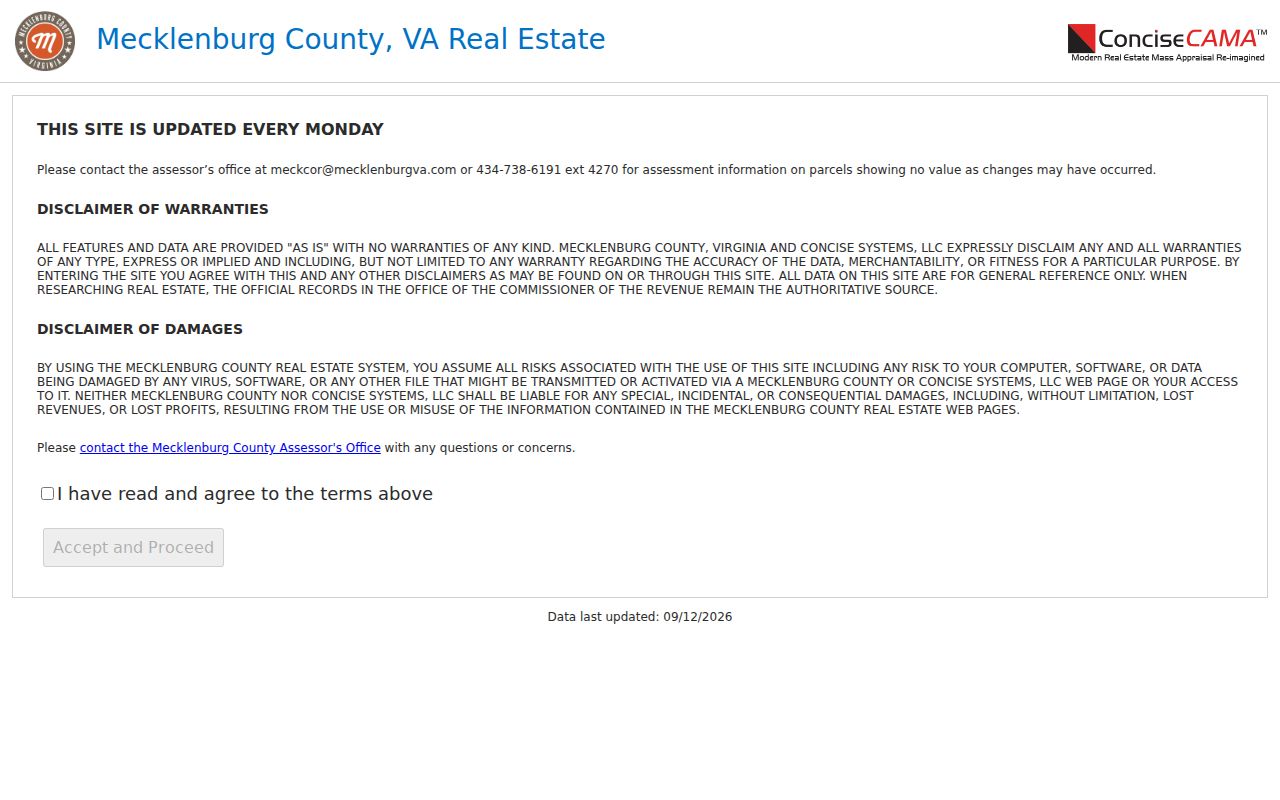
Treat the live tax roll as a snapshot rather than a permanent title record, and keep a dated copy of any Mecklenburg parcel result you rely on.
Confirm the Owner in the Recorded Deed
The Circuit Court Clerk is the county's land recorder. Virginia SRA/COVERS offers remote access to the deed index. Free index-only access varies by clerk, though. Images may require local authorization, a signed agreement, and payment. Search your owner as grantee first. Then read the instrument and its legal description closely. If the image is gated, the Clerk's office in Boydton can explain counter or certified-copy options. A deed beats the tax roll as evidence of a conveyance, since the roll may update later. Even a deed index entry needs context, because a deed of trust secures a loan and an assignment or release is not a new transfer.
Compare Mecklenburg Owner Sources
Each record names a party for its own reason. The assessment roll assigns an owner of record for tax administration. A deed names the grantor and grantee. A GIS parcel adds geographic context. Virginia SCC filings can explain a company's legal identity, but they prove ownership only when the recorded deed ties that company to the land.
| Source | Owner Info It Gives | Access |
|---|---|---|
| Commissioner’s roll | Assessment owner and mailing information, subject to portal limits | Public portal; office file controls |
| Circuit Clerk deed index | Parties and reference for recorded conveyances | SRA index; image access may be restricted |
| GIS and land book | Parcel location and dated assessment context | Public county tools; map is not title proof |
| Virginia SCC records | Entity status and filing context for an LLC | State Corporation Commission CIS |
The owner of record is not always the resident. A mailing address may sit elsewhere because the land is vacant, the owner lives out of county, or title sits with a trust or company. The public roll is not an occupancy list. Virginia's Address Confidentiality Program lets a protected participant use a substitute address. Never try to infer a protected residence. Match people to parcels through documents, not assumptions.
Read the County Owner Card with Care
Field names on the CAMA parcel card can vary, so verify what yours displays. Expect owner, situs, parcel number, and legal description. Land, improvement, and total assessment values usually appear too. Sale history, acreage, tax district, and exemption status may also appear. A blank field does not mean no transaction exists. The county's assessment and ownership portal opens with a disclaimer before any search screen appears. That reference-only warning is the county's own.
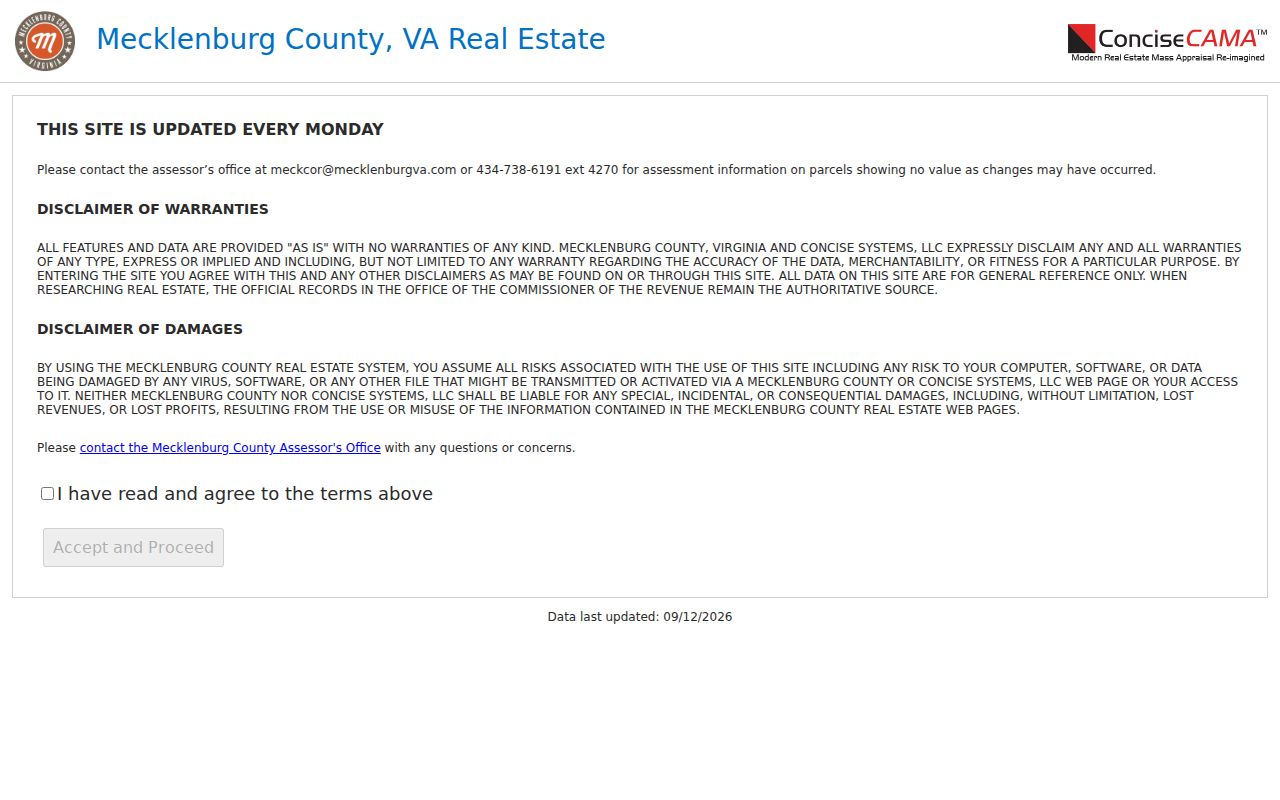
After a recent sale, skip the wait. Take the parcel number straight to the recorded deed rather than waiting for the public roll to update.
Trusts, Companies, and Estate Names
A parcel can sit in a trust, LLC, corporation, estate, or fiduciary name. Search the exact grantee name from the deed. Keep its punctuation and abbreviations. Don't substitute an affiliated individual. Virginia SCC's Clerk Information System adds company filing context, and probate records may explain an executor or administrator transfer. Entity filings are not a people finder. Use them to interpret the named legal owner and to direct property-related requests to the right contact.
Town Tax Does Not Change the Deed Office
Mecklenburg property inside Boydton, Brodnax, La Crosse, Chase City, Clarksville, or South Hill can carry both county and town taxation. That adds a town tax bill. No separate town deed chain or assessor exists. The Circuit Clerk in Boydton stays the land-record custodian, and the Commissioner keeps the assessment roll. A town's zoning or code file can still help. Postal city names do not mark corporate limits. Confirm the parcel on county GIS, then check the town limit with that town's planning or zoning office when jurisdiction matters.
Vesting on a Deed Names the Legal Holder
Vesting tells you how a deed holds title. That language appears on the face of the recorded instrument itself, not in a summary field. The named holder can be one person. It can also be a trust, an LLC, an estate fiduciary, or several co-owners at once. County assessment rolls often abbreviate. The tax roll may format the same legal name differently than the deed does, so matching two entries by eye can mislead you. Compare the exact vesting language first. A deed may also convey only a partial interest. Forms of co-ownership may never appear in a public owner field, so read the instrument and seek title advice when the arrangement affects a purchase, inheritance, or other legal decision.
Reconcile a Mecklenburg Owner Name Across Records
Dates explain most mismatches. When the Commissioner's display and the latest deed disagree, compare when each was set. The deed may postdate the last weekly refresh. The assessment account may retain the July 1 owner for the tax cycle. Or the instrument may be a deed of trust. The county records the deed first. Only then does the Commissioner change the ownership entry, and no average update lag is published.
Keep the right details together. The parcel number, grantor and grantee names, recording reference, deed date, and assessment lookup date all belong in one place. Ask the Circuit Clerk what was filed. Ask the Commissioner whether the official roll has been updated. Similar account names crowd some streets. There, the deed's legal description is a better match than an abbreviated owner label. For an LLC, trust, estate, or fiduciary, preserve the legal party name rather than substituting a person from a separate filing; SCC or probate records can add context, but the recorded deed is what ties that party to the specific land.
Match the Mecklenburg Parcel Before the Person
A name is only a search key, not a parcel identifier. Common surnames repeat. An abbreviated company name or a prior owner can attach to several accounts, especially where land sits in an estate or trust. Check the situs, account number, and legal description to decide whether a result concerns the property you mean. Then verify the conveyance through the instrument reference.
A public owner display is not a people finder. It cannot tell you who lives at an address or how to reach a private person. The county's mailing field exists for tax correspondence. It may belong to an entity, an agent, or someone outside Mecklenburg. Virginia's Address Confidentiality Program shields qualifying participants through substitute addresses. Keep the search tied to the land. Ownership questions go to the Clerk or Commissioner. For a stubborn parcel, stack the sources: GIS for location, the land-book row for dated assessment context, and the deed or plat for the legal description. One matching name is not enough.
Limits of an Owner Lookup
A Mecklenburg County owner lookup names the people and entities tied to public property records. That is all it shows. It proves no occupancy or contact consent. A portal may lag behind a recent deed. An LLC or trust may be the legal owner, so verify answers with legal weight against the filed instrument and a qualified title professional.
Lawful use. Use Mecklenburg County owner information for property due diligence, boundaries, records review, and civic research. Do not use names or addresses to stalk, target, or harass anyone.